Public Space, Public Policy, and Public Understanding of Race and Ethnicity in America by Theresa A. Booker
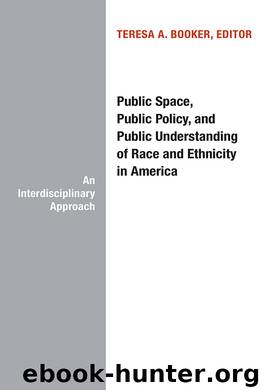
Author:Theresa A. Booker
Language: eng
Format: epub
Publisher: University of Akron Press
CONCLUSION
Asian Indian immigrants in the United States sustain connections with South Asia through food and food rituals. Asian Indian individuals and families also report close connections among foodways and ethnic, religious, and caste identities. Memories of food and food traditions play a central role in reconstruction of Asian Indian ethnic identity in the American context. Seen through the narratives of men and women, Hindus and persons identified with other religions, North Indians and South Indians, first- and second-generation immigrants, elders and youth, parents and students, food represents sustenance and celebration, region and nation, philosophy and heritage, home and business.
Intersections between food and religion are less clear than the scholarly literature suggests. Is vegetarianism a religious mandate or an intelligent dietary practice? Do food rituals associated with religious holidays originate from ethnic, regional, spiritual, or caste/class traditions? Are meat-free kitchens maintained for religious reasons or as a strategy for sustaining family status in the US Asian Indian community? These questions represent areas that might benefit from additional research.
Males, especially first-generation males who arrived in the United States without spouses during the 1960s and 1970s, are more likely to eat meat outside the home than are more recently arrived Asian Indian immigrants. Generally, this tendency can be traced to the lack of vegetarian options in US restaurants and cafeterias more than three decades ago. Some researchers, however, note that as a result of gender role differentiation in India, early Asian Indian male migrants lacked practical knowledge about food preparation (Hickey 2010). In any event, for male graduate students and young professionals from South Asia, reconstruction of the natal environment in US contexts requires family-style dining with roommates or colleagues and the use of Indian spices or vegetarian options. Moreover, some male Asian Indian professionals who arrived in the United States shortly after the 1965 Immigration and Naturalization Act were advised by well-meaning professional colleagues that they must be willing to eat meat to survive. Again, further research is needed for a broader understanding of these issues.
Second-generation US Asian Indians are more likely than their parents to prefer mainstream American foods such as hamburgers and other fast food choices. Younger migrants also are more likely to eat chicken and turkey than are their elders. Women who prefer to cook traditional ethnic meals often adjust their own preferences to accommodate children and/or husbands who have grown to expect diversity in their diets. Mothers prepare vegetarian Italian, Mexican, and Chinese dishes at home as well as regional Indian vegetarian dishes. Families dine out at Chinese and Japanese restaurants since these restaurants offer vegetarian options for practicing vegetarian family members as well as meat-and-vegetable dishes for family members who eat meat.
Conversely, some second-generation Asian Indian immigrants have parents whose strong belief systems help define the family’s US Asian Indian identities. These second-generation immigrants, rather than choosing mainstream American food, hold fast to ethnic teachings. Among these US Asian Indian families, vegetarianism is a lifestyle as well as an identity marker.
The concept of vegetarianism among US Asian Indians varies considerably.
Download
This site does not store any files on its server. We only index and link to content provided by other sites. Please contact the content providers to delete copyright contents if any and email us, we'll remove relevant links or contents immediately.
| Anthropology | Archaeology |
| Philosophy | Politics & Government |
| Social Sciences | Sociology |
| Women's Studies |
Nudge - Improving Decisions about Health, Wealth, and Happiness by Thaler Sunstein(7684)
The Fire Next Time by James Baldwin(5418)
iGen by Jean M. Twenge(5401)
Adulting by Kelly Williams Brown(4557)
The Sports Rules Book by Human Kinetics(4374)
The Hacking of the American Mind by Robert H. Lustig(4359)
The Ethical Slut by Janet W. Hardy(4235)
Captivate by Vanessa Van Edwards(3834)
Mummy Knew by Lisa James(3674)
In a Sunburned Country by Bill Bryson(3526)
The Worm at the Core by Sheldon Solomon(3474)
Ants Among Elephants by Sujatha Gidla(3452)
The 48 laws of power by Robert Greene & Joost Elffers(3208)
Suicide: A Study in Sociology by Emile Durkheim(3004)
The Slow Fix: Solve Problems, Work Smarter, and Live Better In a World Addicted to Speed by Carl Honore(2995)
The Tipping Point by Malcolm Gladwell(2898)
Humans of New York by Brandon Stanton(2860)
Handbook of Forensic Sociology and Psychology by Stephen J. Morewitz & Mark L. Goldstein(2691)
The Happy Hooker by Xaviera Hollander(2682)
